
A Complete Power Factor & Harmonic Solution
ISO 9001 - 2008 Certified Company


Dual-benefit technology: Mitigate harmful harmonics and improve power factor simultaneously using tuned LC circuits.
Request Audit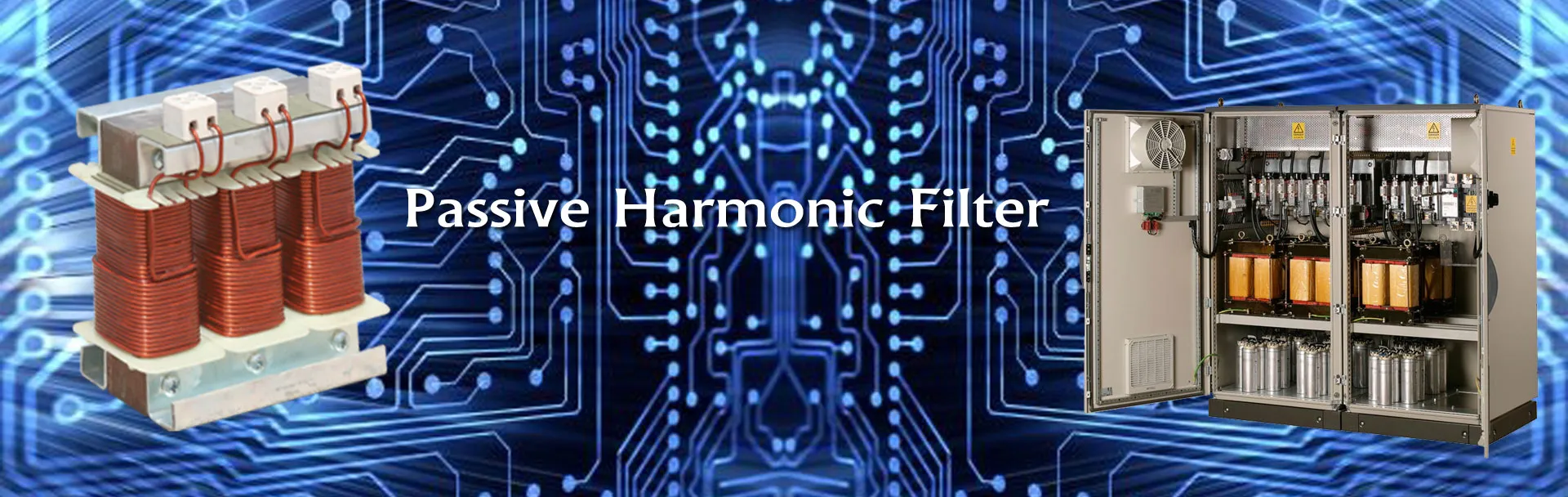
Enhance Power Quality Through Harmonics Mitigation and Power Factor Improvement.
Passive harmonic filters, particularly of the LC (inductor-capacitor) type, are essential components in modern electrical systems. They are designed to address power quality issues caused by non-linear loads like VSDs, rectifiers, and inverters. By forming a tuned circuit, these filters effectively block or redirect specific harmonic frequencies (e.g., 5th or 7th order) while providing reactive power compensation.
Significantly reduces Total Harmonic Distortion (THD) by absorbing dominant harmonic currents.
Improves PF to near unity, reducing kVA demand and eliminating utility penalties.
Prevents overheating of transformers and cables, extending the lifespan of your infrastructure.
A robust, low-maintenance alternative to active filters for stable loads with predictable harmonics.
Our LC filters incorporate specialized components tailored for durability in high-voltage environments:
These inductors are connected in series with capacitors to shift the system's resonance frequency away from problematic harmonics. A 7% detuning (common in 50 Hz systems) creates a resonance at ~189 Hz, safely below the 5th harmonic (250 Hz).
We use premium capacitors from trusted brands like EPCOS, L&T, Shreem Electric, and Momaya.
| Component | Technology | Key Properties | Typical Brands |
|---|---|---|---|
| MPP Heavy Duty | Metalized Polypropylene | Self-healing, High overvoltage tolerance (110%), Low dissipation factor. | EPCOS (TDK), L&T, ABB, Schneider |
| APP Heavy Duty | All Polypropylene (Film-Foil) | Extreme durability, High current handling (1.5x), 5-year warranty options. | Shreem Electric, Momaya, Malde |
Designing an effective passive filter requires a site-specific approach:
Contact PS Power Controls for a customized LC filter design and quote.
Tailored LC circuits designed for your specific load profile.
Explore complementary power quality solutions to improve efficiency, reduce penalties, and improve equipment reliability.
APFC Panel | Active Harmonic Filter | Passive Harmonic Filter | Energy Audit Services | Get Technical Consultation
PS Power Controls supports end-to-end implementation across Chennai and Tamil Nadu, including load assessment, solution sizing, panel integration, and commissioning guidance. Our engineering recommendations are based on real operating conditions, utility penalty behavior, and site reliability priorities.
For project planning, combine this solution with energy audits, harmonic analysis, and consultation from our technical team. This approach improves power quality outcomes while reducing rework risk during deployment.